
Di come si sceglie la carta per un dizionario e delle decisioni che riguardano dettagli marginali o marginalizzati.
Di Craig Mood
Di come si sceglie la carta per un dizionario e delle decisioni che riguardano dettagli marginali o marginalizzati
Di come si sceglie la carta per un dizionario e delle decisioni che riguardano dettagli marginali o marginalizzati.
Di Craig Mood

Le due maschere di Beethoven: iperrealismo, mitopoiesi e arte funebre, in:
L’immagine come pensiero.
Forme e metamorfosi dell’ideale umano da Herder a Benjamin,
a cura di Chiara Sandrin,
pp. 162, € 15, Torino, Trauben editore
Questo saggio affronta tre argomenti: dapprima esamino come la realtà, attraverso la maschera da vivo di Beethoven, s’insinuò in un’opera d’arte (il suo busto modellato da Franz Klein). In questa prima sezione metto a fuoco quale responsabilità abbia l’artista nel riprodurre un soggetto, vale a dire quale sia la riproduzione del reale “legittima” .
Discuto poi della mitopoiesi beethoveniana, ovvero la metamorfosi che l’immagine del compositore, in atto già quando era ancora in vita, subì nelle parole di chi lo incontrò personalmente.
Affronto infine la genesi della maschera funebre in parallelo col racconto del decesso del compositore tramandato da un suo contemporaneo. Sarà risolto un grande mistero e data risposta alla domanda: perché sempre più spesso si confonde la maschera di Beethoven “dal vivo” di Franz Klein (1812) con quella funebre realizzata da Josef Danhauser nel 1827?
Alcuni riferimenti iconografici:
Franz Klein, maschera dal vivo di Beethoven, 1812, Beethoven-Haus, Bonn
Anton Dietrich, gesso tratto dal busto di Beethoven, 1890 circa
Arnold Hermann Lossow (da Anton Dietrich), busto di Beethoven (occhi con le pupille), Walhalla
Josef Danhauser, gesso tratto dal busto di Beethoven, 1890 circa
Franz Klein, busto di Beethoven, realizzato con l’ausilio della maschera, 1812, Kunsthistorisches Museum, Sammlung alter Musikinstrumente, Neue Burg, Wien
Franz Klein, fine XIX sec.-inizio XX sec., copia in bronzo di H. Leidel del busto di Beethoven del 1812, Beethoven-Haus
Ferdinand Schimon, Beethoven, 1819, Beethoven-Haus
Josef Danhauser, calco in gesso della maschera mortuaria di Beethoven, post 1827, Beethoven-Haus
* * *
Il tema era stato oggetto di presentazione nel ciclo di incontri seminariali di letteratura, arte e filosofia, a cura di Chiara Sandrin, nell’ambito della ricerca “La responsabilità dell’arte”:
Bild, Vorbild, Nachbild. Immagine, forma, metamorfosi dell’umanità come ideale.
20 febbraio 2013, h. 18, III piano, Palazzo Nuovo, Torino
Le due maschere di Beethoven

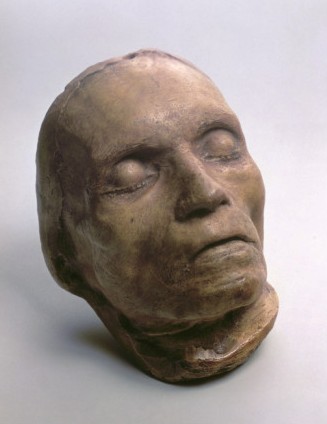

La maschera di Franz Klein posseduta da Theodore Thomas, fondatore della Chicago Symphony Orchestra
In What Do Musicologists Do All Day (WDMDAD) we investigate the use of technology in the work of music researchers in the widest sense.
Researchers frequently make use of the possibilities that mobile phones, social media, digital libraries, search engines and computer software offer. But these technologies do not always have a good fit with daily work practices. We would like to discover what needs to be done to make this fit better, and what successful practices already exist that we can learn from.
For this, we have created a short questionnaire, in which we would like you to tell us about your ideas and experiences. Whether you do not use much technology, or if you use it a lot, we are interesting in finding out your views. Please take our questionnaire at https://opinio.ucl.ac.uk. We much appreciate your participation.
Charles Inskip is a lecturer at University College London specialising in digital scholarship, Frans Wiering is an assistant professor at Utrecht University and chair of the IMS study group in Digital Musicology.
If you have any questions, please contact us at wdmdadsurvey@gmail.com
Please feel free to circulate this message among interested music researchers worldwide.
Charles Inskip and Frans Wiering

BAM, BAM, BAM, BAAAAM!
Il mito di Beethoven raccontato a fumetti
Dopo il successo delle mostre Mozart a Strisce (2011), Wagner a Strisce (2012) e Sempre Verdi (2013) allestite da WOW Spazio Fumetto a Milano per celebrare l’inaugurazione della stagione lirica del Teatro alla Scala, il museo quest’anno propone una mostra dedicata al mito di Ludwig van Beethoven, autore del Fidelio con cui La Scala apre la stagione 2014-2015.
Dai Peanuts a Pippo, dal fumetto americano alle eleganti scene delle Figurine Liebig, un viaggio nel mondo del fumetto e dell’illustrazione sulle tracce di Ludwig van Beethoven.
Martedì 16 dicembre 2014
in occasione del compleanno di Beethoven, WoW Spazio Fumetto apre gratuitamente le sue porte, dalle 10 alle 20, a tutti i musicisti, gruppi e orchestre che vogliono eseguire brani del Genio di Bonn per una giornata di grande musica!
WOW Spazio Fumetto
museo del fumetto, dell’illustrazione
e dell’immagine animata
viale Campania 12, 20133 Milano (MI)
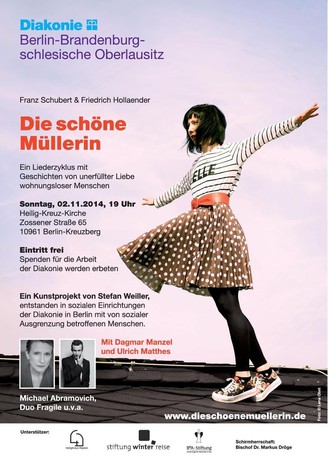
Quale relazione possa esserci fra la “Schöne Müllerin” di Schubert e i senzatetto giunti a Berlino sembra, a una prima occhiata, difficile da capire. E sulla carta pare anche un’idea (artisticamente) rischiosa. Stefan Weiller si è messo in ascolto. Si è accorto che molti senzatetto erano accomunati da storie d’amore infelici o non ricambiate, le quali li hanno condotti a vivere in strada.
Weiller ha costruito un intero progetto artistico attorno alla “Bella mugnaia”: ha avuto a disposizione il meraviglioso spazio della Heilig-Kreuz-Kirche, due ottimi attori, Dagmar Manzel e Ulrich Matthes, il soprano Christina Schmid, il mezzosoprano Susanna Frank, il bravo tenore Theodore Browne, il pianista Hedayet Djeddikar e l’arpista Monica Rincon, il Duo Fragile, Daniela Fonda a introdurre e un coro. All’originale ciclo liederistico sono intervallate le storie frammentarie dei senza fissa dimora e alcune canzoni di Friedrich Hollaender.
Come sia facile scivolare in una via senza ritorno, lo chiariscono bene le voci di questi “non visti” che incontriamo ogni giorno nella metro, sulla U-Bahn, sotto i ponti: e così il vagare, l’iniziale gioia dell’io narrante, che non conosce riposo né giorno, né notte, assume un senso diverso, nuovo, cui non avevamo mai pensato prima.
Io non so che mi successe,
Né chi mi diede il consiglio,Anch’io dovetti scendere
Con il mio bastone da viandante.
Ascoltare Schubert attraverso queste storie è straniante: l’opera d’arte ne esce rivitalizzata e noi usciamo (e andremo per sempre) nel mondo con altri occhi.
Prima esecuzione assoluta: 2 novembre 2014, Heilig-Kreuz-Kirche, Zossener Str. 65, 10961 Berlino.
Realizzato grazie a: Diakonische Werk Berlin-Brandenburg-schlesische Oberlausitz
Prossima data: 18.1.2015, St. Petri Kirche, Hamburg


Devi effettuare l'accesso per postare un commento.